Published:
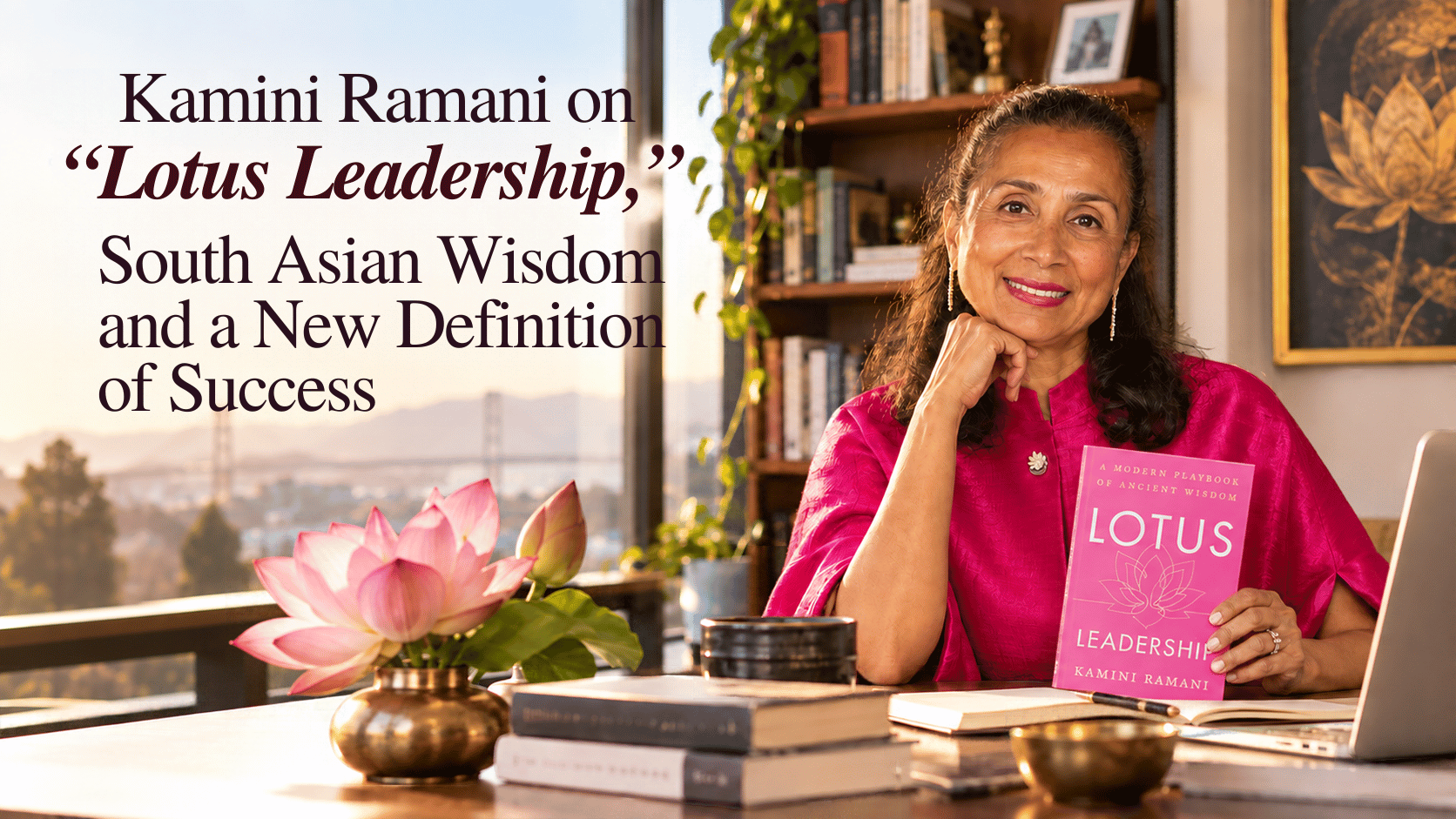
Kamini Ramani on “Lotus Leadership,” South Asian Wisdom and a New Definition of Success
Kamini Ramani’s professional life has crossed disciplines that might initially appear unrelated. She studied English literature in Mumbai and at Yale, continued her education in communications at Stanford, spent four decades working in Silicon Valley, and later served for nearly two decades as chief marketing officer at the venture capital firm Mayfield. Today, those experiences come together in “Lotus Leadership,” her exploration of leadership through the lives and perspectives of accomplished South Asian women.
As part of Sanskar Savvy’s continuing coverage of the 2026 South Asian Literature and Art Festival, Dr. Bindu Ranaut spoke with Ramani about the ideas behind the book, the influence of literature on her career, her experience working with Steve Jobs at NeXT, and the role cultural inheritance can play in shaping contemporary leadership. Ranaut, whose own professional background spans higher education, writing, and communication, approached the interview with a focus on both Ramani’s accomplishments and the ideas about culture, identity, and leadership that have developed across her career.
The interview also speaks directly to Sanskar Savvy’s mission to Celebrate, Explore, Connect! It gives us a chance to celebrate the experiences of South Asian women whose leadership has often received less public attention, explore the cultural foundations behind Ramani’s work, and connect those ideas to wider conversations about ambition, identity, family, education, and professional life.
Storytelling as the Thread Between Literature and Leadership
When Ranaut asked Ramani what connected English literature, communications, technology, venture capital, and authorship, Ramani identified storytelling as the consistent thread.
“The common thread, I think, in my career and in life is storytelling,” she said. “I love reading stories, writing stories, listening to stories. I think that’s what really makes us human.”
Born and raised in Bombay, now Mumbai, Ramani studied English literature at Elphinstone College, continued her studies at Yale on scholarship, and later earned a second degree in communications at Stanford before entering Silicon Valley.
Ramani said her background in literature continued to shape the way she approached leadership. Reading, she explained, taught her to consider perspectives beyond her own, a habit she believes helps leaders develop empathy and better understand the people around them.
The conversation then turned to education and the changing nature of work. Ramani questioned the assumption that liberal arts degrees are less practical than technical ones, arguing that AI is increasing the value of people who can write, interpret, communicate, and move across disciplines.
Ramani pointed to her younger daughter as an example. A Stanford graduate, she combined computer science with a minor in poetry and, Ramani said, has developed a strong interest in AI ethics. She contrasted her daughter’s experience with that of some young graduates who focused more narrowly on coding, arguing that AI is reshaping which skill combinations may prove valuable.
Her point was that connecting ideas across disciplines is increasingly valuable, a pattern reflected in her own career.
Lessons From Silicon Valley and Steve Jobs
In 1995, Ramani worked with Steve Jobs at NeXT, when his career was far less secure than it would later appear. Ramani recalled that many people had begun to dismiss Jobs. During the same period, Pixar released Toy Story and went public, and Apple acquired NeXT the following year, eventually bringing him back to Apple.
For Ramani, the experience offered a lesson in persistence. She described “audacity” as one of the qualities she came to associate with Jobs and emphasized the importance of continuing to believe in one’s abilities even when circumstances suggest otherwise.
The second lesson was preparation. Ramani watched Jobs rehearse extensively before major presentations, an experience that later shaped the advice she gives women she mentors: “Invest in your communications.” Her long career in Silicon Valley also changed how she thought about success. She lived through the dot-com collapse, the 2008 financial crisis, the rise of cloud and mobile technology, and now AI. Watching fortunes expand and disappear made wealth alone feel like an unstable measure of a meaningful life.
She compared that with a broader idea of abundance, one she associated with Lakshmi. Prosperity matters, she explained, but abundance can also encompass family harmony, supporting a team, and contributing to the people and communities around you.
Why “Lotus Leadership” Began With a Question About Visibility
After decades in Silicon Valley, Ramani began reconsidering how success is measured and whose success is most often recognized. She told Ranaut that conversations about Indian American achievement frequently centered on prominent male executives, including Satya Nadella, Sundar Pichai, Arvind Krishna, and Shantanu Narayen.
Ramani made clear that those accomplishments deserve recognition. Her question was why equally interesting stories about South Asian women were less frequently part of the same public conversation.
“I’ve met so many amazing women leaders,” she said, explaining that she wanted to understand both their professional journeys and the ways they approached leadership.
Ramani eventually spoke with approximately 100 women and selected more than 30 to profile in “Lotus Leadership”. Rather than focusing only on titles and promotions, she asked how these women actually led and what experiences shaped their decisions.
One pattern stood out. Many of the women were deeply integrated into American professional culture while still drawing on their South Asian heritage. Ramani heard references to dharma, karma, respect for elders, collective responsibility, family, and broader concepts of abundance. When she asked participants about leaders who had inspired them, some identified figures such as Saraswati and Lakshmi and connected those figures with knowledge, curiosity, prosperity, and harmony.
Those conversations shaped “Lotus Leadership” around five qualities Ramani calls the Five Petals: Fusion, Curiosity, Harmony, Abundance, and Power. Ramani connected the lotus emerging from mud to the challenges many women faced before reaching leadership positions. She also saw the flower as a symbol that can hold multiple qualities at once.
That became central to her examination of expectations placed on women. Leadership is often presented through oppositions: assertive or compassionate, ambitious or empathetic, strong or warm. Ramani said the women she interviewed frequently rejected those divisions.
She called that expectation the “either-or tyranny” and explained that many of the leaders in the book were instead “living in the and.” One woman described herself as having a dazzling smile while also being a ruthless negotiator. Another said that although she was 5-foot-2 and feminine in appearance, when she spoke, “concrete and steel comes out.”
Since its release, “Lotus Leadership” has also reached the USA Today Bestseller list, a milestone Ramani recently shared while emphasizing that what matters most to her is seeing readers use the lessons of the 33 women featured in the book to build meaningful careers and lives.
Harmony, Curiosity and the People Who Help Make Success Possible
When Ranaut asked which of the five petals had challenged Ramani’s own thinking the most, Ramani chose Harmony, one of the findings she described as most surprising.
Among women in long-term partnerships, Ramani repeatedly heard descriptions of relationships in which careers, caregiving, children, aging parents, and community responsibilities were treated as shared projects. That differed from the familiar narrative in which women’s professional ambitions are expected to compete with family responsibilities.
Ramani cited Shalini Govil-Pai, a senior leader at Google who previously worked at YouTube and Pixar. Across a marriage spanning more than 30 years, Govil-Pai and her husband alternated professional priorities based on what their family needed. Over time, both advanced professionally while raising children and caring for aging parents.
For Ramani, the point was not that every household should follow one model. It was that partners could understand career and family responsibilities as something they plan and support together. Ranaut then asked how South Asian cultural and philosophical ideas could enter contemporary leadership without being reduced to another corporate formula. Ramani responded by focusing on Curiosity, another of the Five Petals.
Within the framework, Curiosity is associated with Saraswati and can involve experimentation, career changes, sabbaticals, and unfamiliar opportunities. She contrasted climbing a career ladder with moving across a rock wall. A career may require lateral movement, pauses, changes in direction, and calculated risks rather than constant upward progression.
Ramani pointed to Anu Bharadwaj, who took a wildlife-conservation sabbatical before later becoming president of Atlassian, and Priya Abani, who left a stable role at Intel, later led Amazon Alexa, and eventually became a chief executive.
She extended the same idea to South Asian families. “Take the lid off the pressure cooker,” she told Ranaut, encouraging parents to give children greater room to experiment rather than insisting on a single predictable model of success.
The discussion then turned to the relationships that support women’s advancement. Ramani distinguished among mentors, sponsors, and champions. A mentor provides guidance, a sponsor advocates for someone when that person is not present, and a champion becomes actively invested in creating opportunities and helping another person succeed. She also stressed the importance of supportive partners, parents, colleagues, and champions, while arguing that external support cannot replace personal conviction.
Heritage as Learned Wisdom
Ranaut closed the interview by asking Ramani what she hoped a young woman might understand if she read “Lotus Leadership: A Modern Playbook of Ancient Wisdom” 20 years from now. The question brought the conversation back to cultural inheritance and the role it can play in professional and personal life.
“I think of heritage as learned wisdom,” Ramani said. She described that inheritance as something shaped by family, culture, and lived experience rather than as a fixed set of instructions a person must follow.
Her advice was direct: “Don’t bury it. Don’t run away from it.”
That idea sits at the center of “Lotus Leadership.” The book does not suggest that every inherited cultural idea should be preserved without examination, nor does it attempt to turn South Asian philosophy into a universal management system. Instead, Ramani asks readers to consider what their cultural experiences have taught them, what remains useful, and how those lessons can coexist with contemporary professional life.
Her framework draws on South Asian thought, but Ramani also makes clear that its application is broader. As she told Ranaut near the end of the interview, people do not have to be Indian to practice the principles she describes.
For South Asians living across multiple cultures, those questions are especially familiar. Education, family expectations, relationships, ambition, and professional identity often overlap, and Ramani’s work asks readers to consider how those influences shape the way they lead and define success.
Readers can learn more about “Lotus Leadership,” the Five Petals framework, the women featured in the project, and where to find the book through the official “Lotus Leadership” website.
From SALA to the Sanskar Community
Ramani’s conversation with Dr. Bindu Ranaut is part of Sanskar Savvy’s continuing SALA 2026 coverage, extending the festival’s conversations about literature, culture, identity, and the experiences shaping South Asian communities. Through questions about Ramani’s career, her research, and the ideas behind “Lotus Leadership,” Ranaut repeatedly returned to how culture, family, education, and lived experience can shape how women understand leadership and success.
This is where the Sanskar Savvy mission to Celebrate, Explore, Connect! fits naturally. We celebrate the women whose experiences Ramani believed deserved greater visibility, explore the South Asian ideas that inform her approach to leadership, and connect those ideas with a community that continues to define success on its own terms.
Stay Updated with Us!
For the latest in music, contests, exclusive interviews, and South Asian culture, check out our latest articles about movies, event announcements, and diaspora achievements throughout North America.
Sign up for our newsletter to receive movie updates, curated playlists, artist spotlights, and cultural stories delivered straight to your inbox.
Want to be a part of the Sanskar community? See how you can partner with us!
Follow us on Instagram, Facebook, and YouTube to keep the celebration going. Have an artist or tour you want us to cover next? Drop us a tip. We’re always listening!