Published:
Navratri 2026: How Garba Found a Second Home in the Diaspora
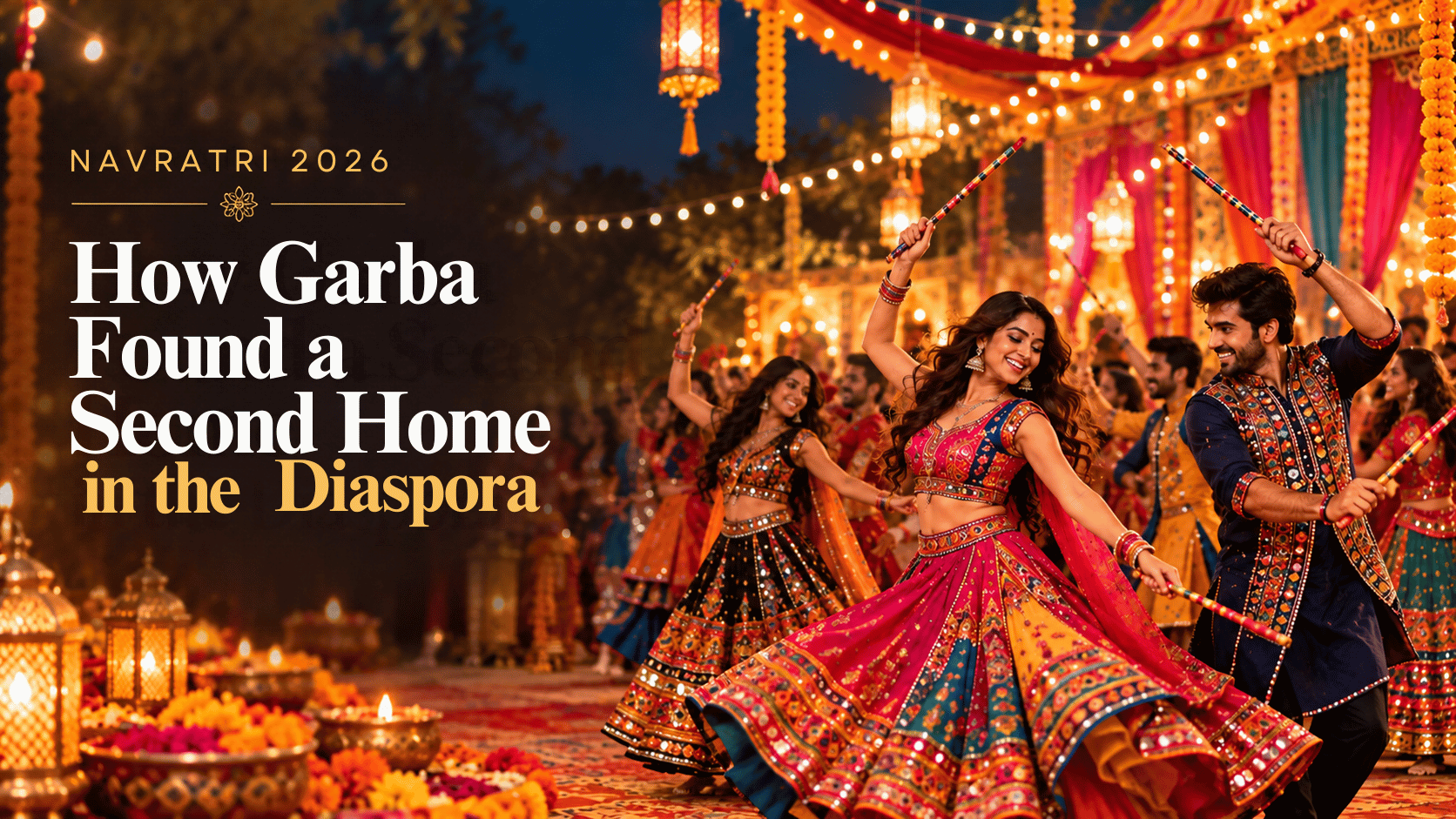
By late September, Garba season in North America is already well underway. Event flyers have been circulating for weeks. Group chats are deciding which nights to attend. Touring artists move between cities, and people who really love Garba may already have several weekends booked before Navratri begins. That says something about how much the celebration has changed here.
What was once organized largely through temples, cultural associations, and community groups now exists alongside major venues, touring artists, and large live productions. In some cities, pre-Navratri has become a season in its own right. Garba is also showing up during Chaitra Navratri in the spring. Community and charity Garbas can happen at other points in the year.
For many South Asians living outside India, Garba is no longer something that appears for nine nights and disappears until the following fall. At Sanskar Savvy, we Celebrate, Explore, Connect! with the traditions shaping life across the diaspora. As Navratri approaches, we are looking at how Garba traveled with immigrant communities, grew alongside them, and gradually found a second home in North America.
A Community Large Enough to Build Its Own Traditions
Garba has grown alongside the communities that organize and attend it. Between 2010 and 2020, the Asian Indian alone population in the United States grew by 54.7 percent to nearly 4.4 million people, according to the U.S. Census Bureau. (Census.gov)
Canada also has large South Asian population centers. In the 2021 Census, more than 1.18 million people in the Toronto metropolitan area identified as South Asian, representing 19.2 percent of the region’s population. (Statistics Canada) Those figures include communities much broader than the Gujarati population most closely associated with Garba. Still, they help explain the environment in which festivals like Navratri have grown. Large communities can support cultural organizations, businesses, and events on a scale that was harder to build when diaspora populations were smaller. A tradition needs people who remember it, but it also needs people who keep showing up.
Bringing Garba With You
For earlier generations of immigrants, celebrating Navratri often meant creating the experience locally. A temple, cultural association, or group of families might find a school gym, banquet hall, or community space, arrange music and food, and bring everyone together for the night.
For someone who had celebrated Navratri in India, that could bring back something familiar. For parents raising children abroad, it gave their kids a way to experience the tradition firsthand. You did not have to explain Garba to a child when they could simply join the circle.
Over time, those local events became traditions in their own right. Families returned every year. Children grew up. The communities around them got larger. And eventually, some of the rooms got larger too.
From Community Halls to Major Venues
Today, a North American Garba can look very different depending on where you go. Local temple and community events still exist, but they now share the calendar with large productions built around touring artists.
On September 12 this year, Atul Purohit is scheduled to perform at First Horizon Coliseum in Greensboro, North Carolina. It is the kind of venue that also hosts major concerts, sports, and other large entertainment events. (Greensboro Complex)
In the Greater Toronto Area, Navrang Navratri Festival Canada’s 2026 lineup began in early September with Atul Purohit, Geeta Rabari and Aditya Gadhvi. Other dates continue into October. (Navrang Navratri Festival Canada)
For some people, Garba night still means returning to the same local event they have attended for years. Others want to see a favorite singer with a large crowd. Plenty of people go to both. The bigger point is that Garba now has an audience big enough to support both versions.
Garba Has Its Own Economy Now
That growth is visible beyond crowd size. A large Garba can involve touring musicians, local promoters, venues, sound and lighting crews, ticketing platforms, sponsors, food vendors, photographers, and clothing and jewelry businesses. For a few weeks each fall, an entire live entertainment economy grows around a cultural tradition.
A longer Garba calendar extends that season even further. Touring artists can perform across several cities. Local businesses get access to thousands of potential customers. People shop for new chaniya cholis, kediyus, and jewelry. Restaurants and vendors serve crowds that may spend most of the evening at the venue. None of that replaces the cultural reason people are there. It shows how much infrastructure has developed around the demand for the experience.
Garba also received major international recognition in 2023, when UNESCO inscribed the Garba of Gujarat on its Representative List of the Intangible Cultural Heritage of Humanity. UNESCO describes it as a ritualistic and devotional dance performed during Navratri in worship of feminine energy, or Shakti. (UNESCO) The tradition is old. The ecosystem surrounding it in North America is much newer.
Growing Up With Garba Here
An entire generation now never had to bring Navratri from India. They grew up with it here. For many Indian Americans and Canadians, memories of Navratri are tied to places like New Jersey, Toronto, Chicago, Houston, or Atlanta. Their first Garba may have happened at a temple, a school gym, or a local community event. They might have learned the steps from their parents, cousins, or by standing near the edge and copying everyone else.
That creates a different relationship with the tradition. For someone who immigrated to North America, a Garba here may remind them of celebrations they attended in India. Their children may have no earlier version to compare it to. The convention center in New Jersey or the community hall outside Toronto is not a substitute for their Navratri experience.
It is their Navratri experience. It is still part of their heritage, but it is also part of their childhood here. You don’t have to have celebrated Navratri in Gujarat to feel like Garba is yours.
The Music Has Changed With the Crowd
Garba music has evolved alongside the events. Traditional songs remain at the center of Navratri, but larger live bands, contemporary arrangements, and artists with international followings have become part of the season too.
You can see the mix in the crowd. There are people who know every word to songs they have heard for decades. Beside them may be someone who came because a friend invited them and learned two-step Garba a few days earlier. They still end up dancing in the same circle. That flexibility matters. Garba has changed over time, but people have continued finding their way into it.
Pre-Navratri Is Now Part of the Calendar
The clearest sign of how much the culture around Garba has changed may be the calendar itself. In many North American communities, you no longer need to wait for the official nine nights of Navratri.
Pre-Navratri events can start weeks earlier. The Gujarati Mandal of Calgary, for example, lists a Seniors’ Pre-Navratri Celebration for September 12 this year, followed by Garba classes the next day and larger Navratri events beginning September 18. Its 2026 schedule then returns to the BMO Centre for additional Navratri dates at the end of October. (Gujarati Mandal Calgary.) For people who enjoy Garba, September and October can start to feel like their own social season.
One weekend may be a community Garba. The next might mean driving to another city for a particular artist. Then someone sends another flyer to the group chat. There is always one more event.
Then There Is Chaitra Navratri
Garba’s calendar is beginning to stretch beyond the fall too. Chaitra Navratri takes place in the spring and has traditionally had a different emphasis from the large Garba culture associated with Sharad Navratri. But diaspora communities are beginning to organize Garba around Chaitra Navratri, too.
In April 2026, more than 300 people attended the second annual Chaitra Garba Night & Bollywood Beats in South Brunswick, New Jersey. The event raised more than $25,000 for charity. (The South Asian Times) It’s worth noting that it’s already in its second year.
It suggests that Garba is becoming useful to diaspora communities beyond one festival season. It can be a fundraiser, a community event, or simply a reason to gather again in the spring. Add pre-Navratri celebrations, university Garbas, and other community events, and the old idea of putting dandiya sticks away for eleven months no longer quite fits. Garba is becoming a year-round part of diaspora life.
Why That Shift Matters
There are easier ways than ever to stay connected to South Asian culture. Music is available instantly. Families living on opposite sides of the world can talk every day. Someone can watch a Garba performance from Gujarat without leaving their home in New Jersey. But watching it is different from being there. At a Garba, you have to join the circle. You figure out the steps. You recognize someone from last year. You bring a friend who has never been before.
The room might include grandparents who grew up celebrating Navratri in India and young adults whose entire experience of the festival has happened in North America. That is where the diaspora story gets interesting. The first generation carried the tradition with them. Later generations did something else. They built their own memories around it.
And now, those communities are changing the calendar too. Garba is happening before Navratri, during Navratri, during Chaitra Navratri, and at other community events throughout the year. The venues may be bigger and the season may be longer, but people keep coming back to the same thing: the circle.
As Navratri 2026 approaches, Sanskar Savvy will continue to Celebrate, Explore, Connect! with the traditions, people, and communities shaping South Asian culture across the diaspora.
Follow us on Instagram, Facebook, and LinkedIn for more stories from across the community.
Have a tradition, event, or community story you think we should cover? Drop us a tip. We’re always listening.